
Customer service, customer journey, and customer experience are not three names for the same thing; they nest. Customer service is a single type of touchpoint, the customer journey is the timeline those touchpoints sit on, and customer experience is the whole system the timeline lives inside, including what your client feels when nobody is touching them at all.
Most founder-led businesses I talk to use all three terms interchangeably, and every time they do, it costs them something. It costs them the ability to tell where their business is actually leaking, because they end up patching a service issue when the problem is upstream in the journey, or refreshing the journey when the problem is downstream in the feeling their clients are leaving with.
According to Zendesk’s CX Trends 2026, 83% of consumers believe customer experience should be far better than it is today, and the gap between what those consumers feel and what businesses think they are delivering is almost entirely the difference between what the business measured (a fast reply, a clean invoice, a friendly rep) and what the client actually felt across the whole thing.
This piece is here to sort the three terms out, in the order a founder-led business actually needs them. If you finish this and can explain the difference to your team over coffee, you are in a stronger position than most businesses in your category, because most of them have never bothered.
Customer Service, Customer Journey, and Customer Experience Defined
Customer service
Customer service is what happens when a client needs something from you and reaches for help, or when you proactively touch them at a specific moment: the reply to their email, the packaging the order arrives in, the person on the phone when the shipment is late, the follow-up after a session. It is a single type of touchpoint, transactional and moment-bound, built to solve a specific problem or deliver a specific interaction. Service is the piece that gets the most attention in most founder-led businesses because it is the most visible, the easiest to describe on a website, and the easiest to fix in isolation.
Customer journey
The customer journey is the sequence of moments a client moves through with your business, from the first time they hear about you, through the sale, through delivery, through offboarding, all the way to whether they come back and whether they refer someone else. It is the timeline, mapped end to end, and every service touchpoint sits somewhere on it. A good journey has intention behind the order, the transitions, and the pacing; a bad journey has whatever the calendar, the software, and the last person who touched it happened to allow.
Customer experience
Customer experience is the whole system the journey lives inside, including all the touchpoints, all the transitions between them, and all the space in between, when your client is not talking to you at all but is still forming an impression of your business. It is not what you do; it is what your client feels, believes, and remembers about working with you. Experience is the thing that determines whether they refer you, whether they come back, and whether they defend you when someone else raves about your competitor.
How Customer Service, Customer Journey, and Customer Experience Fit Together
Imagine three concentric circles. The smallest circle in the middle is customer service: a single moment of contact, a specific job to be done. The circle around it is the customer journey: the sequence of all those moments, plus everything the client passes through on the way. The biggest circle, the one that holds the other two, is customer experience: everything the client feels and takes away, including the parts of the relationship where nothing visible is happening but they are still watching, still remembering, still deciding.
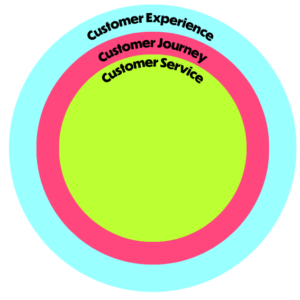
This matters because most conversations about improving “the client experience” collapse into conversations about improving customer service, and the two are not the same problem. You can have a flawless service moment inside a broken journey and lose the client anyway. You can have a beautifully mapped journey and still leave the client with a flat, forgettable feeling because nothing about the experience was designed for how they would feel in between the touchpoints.
Here is the comparison, side by side:
| Customer Service | Customer Journey | Customer Experience | |
|---|---|---|---|
| What It Is | A specific touchpoint | The full timeline of touchpoints | The whole system, including the space between touchpoints |
| Scope | One moment | Beginning to end | Every impression, everywhere |
| Who owns it in a founder-led business | Often the founder or a customer-facing lead | Usually nobody (which is the problem) | The founder, whether they realise it or not |
| Where it shows up | The reply, the delivery, the recovery moment | The map, the process, the sequencing | The referral, the repeat purchase, the reputation |
| What gets measured | Response time, ticket resolution, CSAT (satisfaction) on a single interaction | Conversion between stages, time in stage, drop-off points | NPS, retention, referral rate, revenue per client over time |
| What breaks when it fails | One frustrated client at one specific moment | Clients drop off between stages you never checked | The whole business goes quiet: no referrals, no repeat revenue, no reputation |
Bottom line: service is one lane inside the journey; the journey is one dimension of the experience. Treating them as peers is the shortcut that keeps founder-led businesses stuck at “our clients are happy” when what they actually need is “our clients are talking about us.”
Why the Distinction Matters More for Founder-Led Businesses
If you are running a business with anywhere from five to five hundred clients, no CX department, and a growth engine that runs on repeat revenue and word of mouth, this distinction is not academic; it is the difference between a business that compounds and a business that has to work harder every quarter to stay flat.
The dangerous collapse in a founder-led business is this: the team says “we have great customer service” and hears it as “we have a great customer experience.” The service is often genuinely great, because the founder is the one delivering it, and the founder cares. But service alone does not generate referrals. Feelings generate the memories that generate the referrals, and feelings are shaped by the whole experience, not by any single touchpoint inside it.
Bain & Company’s classic work on retention, which they still reference today, shows that increasing customer retention rates by just 5% can boost profits by 25% to 95%. This is the closest thing this field has to a universal truth, and every bit of it points back to experience, not service.
Brittnei Gaudio, founder of Well Nested Living and one of my recent guests on Would Recommend, put it beautifully when I asked her how she frames success with a new client:
“I will start with a question like, ‘What does success look like? At the end of our session together, what does success look like in this space?’ And it is almost always a feeling. It’s almost always ‘I wanna feel more relaxed. I wanna feel like a weight has been lifted. I wanna feel motivated to cook, or excited to spend time with my kids.’ They’re calling us because they actually don’t know what needs to change functionally or systems-wise in order to get them there. They just know that they’re not feeling good and that it’s not working for them, and they’re feeling all the things they don’t wanna feel.”
Brittnei’s clients are not hiring her for the service (the organizing); they are hiring her for the experience (the feeling on the other side), and the journey (the systems and the moments) is how she gets them there. Every founder-led business works the same way, whether they know it or not.
The other reason this distinction matters more, not less, when you are small: as you add team members, the experience is the thing that has to hold. Service can be trained and journey can be documented but experience is the thing that starts to leak the second the founder is not in the room, unless it has been designed on purpose. A customer experience strategy is what keeps the client experience as good when you grow a team or add complexity as it was when it was just you. That is the whole point of doing this work with five clients, and not waiting until you have fifty.
Is customer service the same as customer experience?
No, customer service is a subset of customer experience, not a synonym for it. Service is a specific type of touchpoint (a reply, a fix, a delivery); experience is the whole system a client moves through, including how they feel between touchpoints. You can deliver great service inside a poor experience and still lose the client.
What's the difference between customer journey and customer experience?
The customer journey is the timeline of every stage a client moves through with your business, from awareness to referral; the customer experience is the whole system that timeline lives inside, including what your client feels and remembers about you. The journey is the map; the experience is the territory.
Which matters most for a small business?
Customer experience matters most, because it is the layer that drives referrals and repeat revenue, and those are the two engines a founder-led business runs on. Service and journey are inputs into the experience; they are how you shape it, not substitutes for it.
Can you have great customer service but a bad customer experience?
Yes, and it happens constantly in founder-led businesses. Every touchpoint can be polite, prompt, and professional, and the client can still finish the engagement with no strong feeling about you, which means no referral and no repeat purchase. Great service inside a flat experience is the most common quiet failure I see.
Do I need a customer journey map if I already have great service?
Yes, because a journey map is how you see whether your great service moments are landing in a great sequence, or whether they are landing in the wrong order, at the wrong pace, with the wrong transitions between them. Journey mapping is not about adding more; it is about seeing what is already there.
Who owns customer experience in a founder-led business?
The founder, by default. Even if nobody has been assigned the title, the founder is the one whose taste, values, and standards are shaping every touchpoint the client hits. The work is to make that ownership deliberate and documented, so the experience holds when the founder steps out of the room.