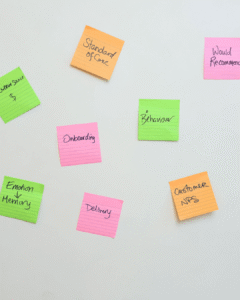

Most founders, when they go to create a customer journey for a service business, list every interaction a client moves through, from the first DM or discovery call all the way to the follow-up long after the invoice clears. And that’s where they stop. But what if you noted what the client is thinking and feeling at each step, so you can finally see the experience from their side of the table instead of yours? What if your customer journey was built around behaviours, thoughts, and feelings rather than automations, integrations, and paperwork? That single shift, from your process to their feeling, is the whole point of the exercise.
Most journey map templates you will find online were built for ecommerce, where the goal is to move an anonymous shopper from an ad to a cart to a checkout, and they fall apart the moment you try to use them for a relationship-based business where the client knows your name and you know theirs. This post walks through what a customer journey map actually is for a service business, why you have to build it from the outside in, and the seven steps to map yours in an afternoon.
What is a customer journey map for a service business?
A customer journey map for a service business is a visual timeline of every touchpoint a client has with you, from first contact through onboarding, delivery, offboarding, and the after, annotated with what that client is thinking and feeling at each stage. It is not a diagram of your process; it is a record of their experience of your process, which is a very different thing.
The distinction matters because a service business runs on relationships, not transactions. There is no cart and no checkout button; there is a discovery call that either felt warm or felt like an interrogation, an onboarding that either dropped the client straight into the good part or made them earn the right to begin, and a final invoice that either landed like a natural goodbye or like a door closing. Those are the moments a stranger later describes at a dinner party when they explain why they would recommend you, and you cannot design them if you have never laid them out in order and looked at them the way a client does. (If you are still untangling how journey, experience, and service relate to each other, this article breaks that down; the short version is that the journey is the timeline, and the experience is the whole system the timeline lives inside.)
Why you have to map the journey from the outside in
Here is the uncomfortable part: you are the worst-positioned person in your business to see your own client journey, because you built it, so every step makes sense to you and none of the friction is visible from where you stand. Bain & Company put a number on this gap back in their 2005 report “Closing the Delivery Gap,” which surveyed 362 firms and found that while 80% of companies believed they delivered a superior experience, only 8% of their customers agreed. That 72-point canyon is not a talent problem or a budget problem; it is a point-of-view problem, and it is exactly what journey mapping exists to close.
The stakes on getting it right have only climbed. PwC’s widely cited “Experience is Everything” report found that 32% of customers will walk away from a brand they love after a single bad experience, which means one badly designed touchpoint on your timeline can undo everything good that came before it. And the upside is just as real: Aberdeen Group research on companies that run formal customer journey management programs found they see 54% greater return on marketing investment and 56% more cross-sell and upsell revenue than the businesses that never map anything at all. Mapping the journey is not busywork you do to feel organized; it is the difference between hoping the experience holds together and knowing that it does.
How to map a customer journey for a service business, step by step
You do not need software or a CX department for this. You need a whiteboard or a blank doc, an honest afternoon, and a willingness to stand on the client’s side of every sentence. A facilitator helps (it is literally what I do, and an outside set of eyes tends to compress the work dramatically), but you can absolutely make a first pass on your own.
1. Name the client and the outcome they came for
Start with one specific client, not “the market,” and write down the actual outcome they hired you to reach, in their words rather than yours. Use an actual client if you can, write down their name, and think about their circumstances. This is not for a “35-45 year old woman, loves Starbucks PSL, reads Cosmo, and drinks green juice”. A map built for everyone maps nothing, and the feeling you are designing for only comes into focus when you can picture the one person moving through it.
2. List every touchpoint from first contact to long after the invoice
Write out every single interaction in order: the Instagram DM, the discovery call, the proposal, the contract, the welcome email, the kickoff, each deliverable, the offboarding, and every follow-up that comes after the work is technically done. Most founders map the middle beautifully and forget that the journey starts before the contract and keeps going long after it, which is precisely where the referrable moments hide.
3. Capture what the client is thinking and feeling at each one
Beside every touchpoint, note the emotion the client is most likely carrying at that moment: the hope on the discovery call, the small anxiety of a first payment, the quiet pride when the first real result lands. Then, think about the actions or behaviours that are happening: are they filling out a form, meeting with your team, or just waiting for something to happen? This is the layer that turns a flowchart into a journey map, because feelings create the memories that create the referrals, and if your map has no feelings on it, you have drawn a workflow and called it a journey.
4. Mark the moments of truth
Some touchpoints carry far more emotional weight than others: the first interaction after someone says yes, the moment something goes wrong, the final handoff. These are your moments of truth, the beats a client will remember and repeat whether you designed them on purpose or not, and they are where your attention earns the highest return.
Sometimes the moment of truth is the wait itself. On a Would Recommend episode with brand photographer Victoria Mae, who explained why she compresses the gap between the shoot and the gallery:
“When people are sitting too long, they start to feel all of those feelings of insecurity that come up in their business, and the hype of the photo shoot degrades; those feelings that happen in the middle muddle into the photos, and I never want that to happen. So I have a 48-hour delivery. When someone books me, they’re booking me not just for their photo shoot day; I block out the day afterwards too, so they get that momentum, none of those feelings are showing up, and they’re still super excited.”
5. Find the friction the client cannot name
Walk the map a third time hunting for friction, the small gates you make a client pass through before they reach the part they came for: the “watch these five videos first,” the third confirmation email, the silence between “I’ll think about it” and their next message. Clients rarely email to complain about friction; they simply feel it and drift, so these gates are the ones costing you the referrals you never knew you almost had.
6. Design the feeling, then the fix
For each moment of truth and each point of friction, decide what you want the client to feel there,decide what you want the client to feel there before you decide what to change, because the touchpoint is only ever the delivery mechanism for the feeling. This is the heart of the Would Recommend Standard, my framework for building an experience worth talking about: you set the 30,000-foot feeling first, and every touchpoint becomes a decision in service of it rather than a task on a list.
7. Build for the version of you with a team
Write down how each designed moment happens so it survives you handing it off, because a journey that only works when the founder is personally paying attention is not a strategy, it is a bottleneck wearing a strategy costume. A mapped, documented journey is what keeps the experience as good when you add a team member as it was when it was just you, which is why this matters more at small scale, not less.
How a service business journey differs from the ecommerce templates
If you have ever downloaded a journey map template and felt like it did not fit, this is why: the default templates are built for a product funnel, and a service journey behaves differently in almost every row.
| Ecommerce / product journey | Service business journey | |
|---|---|---|
| Length | Minutes to days | Weeks to months, sometimes years |
| Touchpoints | Mostly automated and anonymous | Mostly human and named, often you |
| What drives the memory | Price, speed, convenience | How the client felt at the moments of truth |
| Where it breaks | Cart abandonment at checkout | Friction in onboarding and silence after the sale |
| The real goal | Complete the transaction | Earn the referral and the repeat |
Reading a service journey through a product-funnel lens is how founders end up optimizing the wrong things, polishing a checkout they do not have while the discovery call leaks trust. Map for the business you actually run.
Frequently Asked Questions
What is a customer journey map for a service business?
A customer journey map for a service business is a visual timeline of every touchpoint a client moves through, from first contact to post-project follow-up, annotated with what they are thinking and feeling at each step. It captures their experience of your process rather than the process itself, so you can design the moments that turn a satisfied client into one who refers you.
What are the stages of a service business customer journey?
A service business customer journey usually moves through six stages: how they find you, the sale (the discovery call, the proposal, and the yes), onboarding, delivery, offboarding, and the after (whether they come back and whether they refer you). Founder-led businesses tend to under-map the first stage and the last, the stretch before the contract and the stretch after the invoice, which is exactly where the moments that earn referrals live.
How is a customer journey different from customer experience?
The customer journey is the timeline a client travels through; the customer experience is the whole system that timeline sits inside. The journey is one view of the experience, not a separate thing from it, and customer service is a single type of touchpoint on the journey rather than the opposite of experience.
How many touchpoints should a customer journey map have?
There is no correct number; a healthy service map usually surfaces somewhere between fifteen and forty touchpoints once you include everything before the contract and after the invoice. The goal is completeness, not tidiness, because the touchpoints you forget to list are the ones you are not designing.
What tools do I need to map a customer journey?
None beyond a whiteboard or a blank document for the first pass. Software like Miro, FigJam, or a dedicated journey platform can help you maintain and share the map later, but reaching for a tool before you have thought through the client's feelings is how founders end up with a beautiful diagram that changes nothing.
How often should I update a customer journey map?
Revisit it whenever your offer, your delivery, or your team changes, and at minimum once or twice a year. A journey map is a living record of an experience that evolves, not a poster you make once and hang on the wall, and the most useful time to update it is right after a client says something surprised them.