
The Would Recommend Standard is the framework behind businesses people can’t stop talking about: the standard that turns satisfied clients into ones who return, and returning clients into ones who send everyone they know.
It treats operations, client experience, and reputation as one connected system rather than three separate projects, so the business grows, scales, and thrives without the founder in the room.
Most founders come to me asking for one specific fix: they want a better customer journey, or a smarter automation, or a tidier onboarding. Every one of those is a reasonable thing to want. The trouble is that fixing any single piece while the rest stays untended is like painting the outside of a house that was never framed properly: it looks better for a week, and then the same cracks show through in a different spot. This piece walks through what the Would Recommend Standard actually is, the three verdicts it earns you, the nine components that hold it together, and how to tell which floor of the building you’re standing on right now.
The myth that keeps good businesses stuck
Here’s the belief underneath almost every request I get:
“If I just fix my client journey, everything else will fall into place.”
Sometimes it wears a different outfit and shows up as “I need more automation,” but it’s the same hope in both cases, the hope that one clever tweak in one corner of the business is the thing standing between where you are and the word-of-mouth you keep watching other people get.
The client journey matters enormously, and I’ve written a whole guide on how to map one for a service business. But the journey is one piece of a much larger standard, and a beautifully mapped journey sitting on top of chaotic operations and a reputation nobody outside your own client list has heard of will not make anyone rave about you. The difference between the journey, the service, and the experience is the difference between one room and the whole house: the journey is the timeline a client walks through, and the experience is the entire structure that timeline lives inside.
The Would Recommend Standard is what you’re actually building when you stop patching rooms and start building the house on purpose.
What is the Would Recommend Standard?
The Would Recommend Standard is a customer experience framework for founder-led service businesses that connects three things most owners run as separate problems, your operations, your client experience, and your reputation, into a single standard you refuse to drop below in any interaction, whether or not you’re the one in the room.
It exists because the highest compliment in business isn’t a five-star review or a renewed contract; it’s a stranger at a dinner party describing your business to someone who has never heard of you and saying the words “you have to work with them.” That sentence is not an accident of good luck or good vibes. It’s the visible output of a standard held consistently across every touchpoint, long enough and evenly enough that clients stop merely being pleased and start becoming your most ardent salesforce.
The promise at the centre of it is a business people can’t stop talking about that grows, scales, and thrives without you in the room, and everything else in the framework is in service of making that promise true on the days you’re not personally holding it all together.
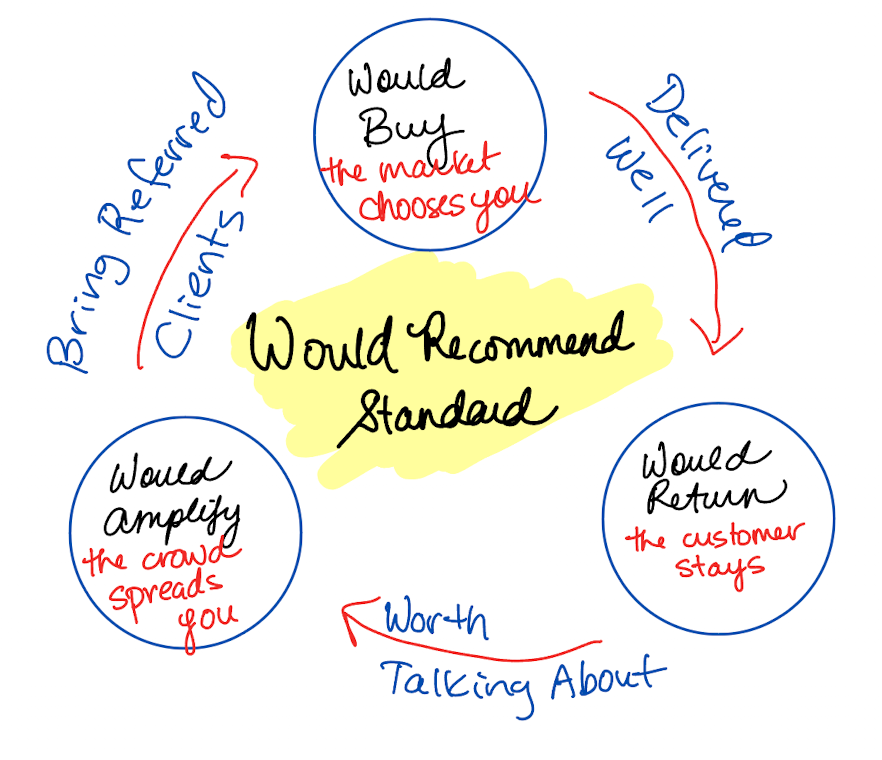
The three verdicts: Would Buy, Would Return, Would Amplify
The reason the standard has “would recommend” in the name is that a recommendation is what you’re ultimately after, and each of these three verdicts is a different audience passing that judgment. They aren’t stages you climb in order and no one of them is a prerequisite for the next; they hold equal weight, and each one is produced when a different pair of your three outcomes is firing at the same time. Most businesses are stronger in one verdict than the others, which is useful to know, because it tells you which pair of outcomes to shore up next.
The market says “Would Buy”.
This is what happens when your operations and your client experience click into place together: the scattered parts of the business become a unified force, the offer is clear, the delivery is smooth, and a stranger who finds you decides you’re worth paying. This is the verdict that gets you chosen in the first place, and plenty of genuinely buyable businesses pour everything into this one corner and then wonder why being purchasable never turned into being talked about.
The customer says “Would Return”.
This is what happens when your client experience and your reputation reinforce each other: a completed transaction becomes an emotional connection, and the client who could shop around decides they’d rather not. This is the verdict that protects everything you’ve built, and it’s worth more than almost anyone budgets for. Bain & Company’s research, led by loyalty expert Fred Reichheld, found that increasing customer retention by just 5% increases profits by 25% to 95%, which means the difference between a client who returns and one who politely disappears is not a rounding error on your revenue; it’s frequently the whole margin.
The community says “Would Amplify”.
This is what happens when your operations and your reputation lock together so completely that you go from best to best known: people who have never worked with you, and don’t know anyone who has, already know your name and want to be in the room. This verdict turns a good business into a known one, and it’s the one people mean when they say “would recommend,” because amplification is the growth engine that compounds while you sleep. It’s also the most trusted one you can own: Nielsen’s Global Trust in Advertising report, which surveyed more than 28,000 people across 56 countries in 2012, found that 92% of consumers trust recommendations from friends and family above every other form of advertising, a level of belief no ad budget on earth can purchase.
None of these verdicts show up as solely a personality trait or a marketing tactic. Each one is the natural result of getting a specific pair of the three outcomes right at the same time, which is why the standard is a system and not a slogan.
The three outcomes the standard is built on
Underneath the three verdicts sit the three outcomes you’re actually managing. Get all three moving in the same direction and the verdicts take care of themselves.
Fluid Operations answers the question, “how do I know my business is doing the right and relevant things to realise my vision?”
It’s the difference between a business where the founder has to point everyone in the right direction every single morning and one where the vision is so embedded in how the work happens that the team moves toward it without being reminded. Fluid operations are what let the business run when you step away, which is the entire point of building one that thrives without you.
Remarkable Experience answers the question, “how do I know my client experience is actually delivering on the promise I made?”
It’s the difference between clients who are plain ol’ satisfied, who got what they paid for and will never mention you to a soul, and clients who are deeply transformed, who feel the intention in every touchpoint and can’t imagine going anywhere else. This is where the moments of truth live, and it’s the outcome most directly tied to whether anyone ever says your name in a room you’re not in. (If you want the tactical version of designing this outcome, the customer journey mapping guide is the how-to that sits underneath it.)
Unshakeable Reputation answers the question, “how do I know my reputation is built on truth and not just good marketing?”
Anyone can write “clients love us” on a website but the question the standard forces is whether what people say about you when you’re not there matches what you believe about your own business, and whether your reputation is earned, rooted in real results and real relationships, or merely asserted. A reputation that only exists inside your own marketing is a story you’re telling; a reputation that travels is a standard other people are repeating on your behalf.
Lisa Simone Richards, co-founder of the stationery brand Pearl Spark Pages, put the reputation piece plainly on a recent Would Recommend episode when she described where her growth actually comes from:
“When I look behind the scenes at where my revenue’s coming from, it’s very much based on community. So it’s nice that it’s all very organic, and I can see it actually coming from the efforts of just having conversations and people who believe in you. These are the women who are raving about me, and they know me, and we have that deeper relationship. You can’t buy that in an ad, you can’t buy that from an influencer.”
— Lisa Simone Richards, co-founder of Pearl Spark Pages
The point underneath Lisa’s line is the point of the whole framework: a reputation that travels is never something you buy, it’s something your experience earns on your behalf, and that experience is either designed to a standard or left to whatever mood everyone happens to be in that day.
The four floors of the building: where is your business right now?
When you look at all three outcomes at once, a business lands on one of four floors. Moving up a floor is the actual work, and naming your floor honestly is the first step, because the fix for a business that’s coasting is completely different from the fix for one that’s surviving.
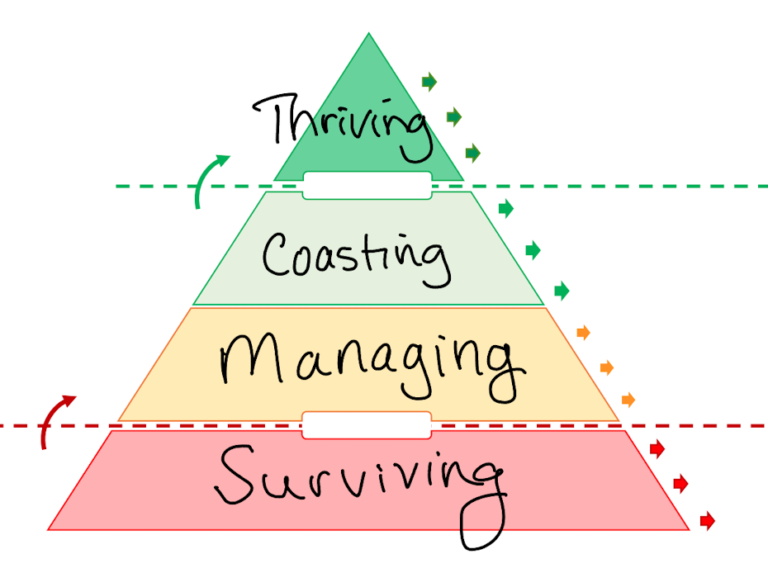
| Floor | Clients Are | Operations Are | Reputation Is | The founder is |
|---|---|---|---|---|
| SURVIVING | Unhappy or Indifferent | Reactive and chaotic | Self-proclaimed | Trapped firefighting, no time to think |
| MANAGING | Basically satisfied | Getting done, but reactively | Contained to current clients | The nervous system holding it together |
| COASTING | Genuinely delighted | Deliberately planned | Referral-driven | Still the ceiling on growth |
| THRIVING | Deeply transformed | Running on visionary momentum | Room-filling | Not the standard; the engine is |
The two hardest jumps are the ones with a lie sitting on the landing between floors.
Between surviving and managing, the lie is “I need more marketing to grow,” when the truth is that your experience is your best marketing strategy and everything else just amplifies it.
Between coasting and thriving, the lie is subtler and it traps the most talented founders: “I’m not enough to have something truly extraordinary.”
Coasting is the dangerous floor precisely because it feels like arriving. Clients are happy, the calendar is full, referrals trickle in, and from the outside it looks exactly like success. But growth has slowly plateaued, and the founder is still the ceiling, which is why so many genuinely excellent businesses spend years mistaking a comfortable plateau for the summit.
You don’t have to be more. You have to build a standard that makes your genius replicable, so the thing that made you special stops living only in your own two hands.
The nine components that hold the standard together
Each verdict is earned by three specific components, nine in total, and this is where the framework stops being philosophy and becomes a build. Think of them like a LEGO set: you can admire the finished thing on the box, but you assemble it one clearly-named brick at a time, and no single brick is the whole model.
To earn Would Buy (operations and experience becoming one force), you build three things:
- Promise is your standard made explicit, the non-negotiables of how you show up in every interaction, even the ones you never personally see.
- Path is the client journey itself, mapped step by step so your time, your people, and your tech actually align instead of tripping over each other.
- Person is your understanding of the client as a living feedback loop rather than a static demographic, knowing how they think, feel, and decide, then serving them on those terms.
To earn Would Return (experience and reputation reinforcing each other), you build three more:
- Moments is the deliberate design of the highest-stakes and highest-reward beats in the journey, the signature touches everyone gets because you decided they would, not because someone remembered on a good day.
- Measurement is putting a stethoscope on the experience to check the health of the business, tracking what the experience actually delivers through reviews, NPS, and the numbers that kill "I think it's working" and replace it with proof.
- Mending is the closed-loop recovery that catches the gaps and closes them before a disappointed client quietly walks away, because the dangerous churn is almost always silent.
To earn Would Amplify (operations and reputation locking together), you build the last three:
- Signals is the system for capturing proof of your impact and feeding what it tells you back into the work, so you keep learning what clients actually want instead of guessing in an echo chamber.
- Script is building referrals into your process so they happen by design instead of by luck, including the words that let the referral travel intact from one person to the next.
- Stage is putting your business where your audience already gathers and packaging your proof into assets that earn the spotlight, so you become the name people bring up when you're not there.
Why the standard compounds when the components don’t
The reason to hold all nine to one standard rather than chasing them piecemeal is that recommendation is the compounding asset, and it only compounds when the components reinforce each other instead of fighting for attention.
A referred client isn’t just cheaper to acquire; they’re a measurably better client. A landmark study by researchers at the Wharton School and Goethe University, published in the Journal of Marketing in 2011, tracked nearly 10,000 customers of a large retail bank and found that referred customers have a 16% higher lifetime value and are 18% less likely to leave than customers acquired any other way.
Sit with what that means alongside the retention number from earlier. The clients who arrive because someone amplified you are the ones most likely to return, which produces more amplification, which brings more of the clients most likely to return. That’s the flywheel the Would Recommend Standard is engineered to spin, and it’s why a business at the thriving floor keeps pulling further ahead while a coasting business, running on the same talent, stays exactly where it is.
The founder in a thriving business isn’t working harder than the one who’s coasting.
They’ve just built the standard that does the work whether or not they’re in the room.
Frequently Asked Questions
What is the Would Recommend Standard?
The Would Recommend Standard is a customer experience framework for founder-led service businesses that connects operations, client experience, and reputation into one standard you hold in every interaction. It's designed to move a business from clients who are merely satisfied to clients who return and then refer, so the business grows, scales, and thrives without the founder personally holding it together.
Who is the Would Recommend Standard for?
It's built for founder-led service businesses, the coaches, consultants, studios, and small service teams running on repeat business and word-of-mouth rather than a paid-ad machine. It's deliberately not written for enterprise CX departments or large agencies, because the whole point is designing a standard that survives at small scale and as you add your first few team members.
How is the Would Recommend Standard different from customer service?
Customer service is one type of touchpoint on the journey; the Would Recommend Standard is the whole system those touchpoints live inside. Service is what you do when something needs handling, while the standard governs every interaction by design, including all the moments that never involve a problem at all.
What does "Would Buy, Would Return, Would Amplify" mean?
They're the three verdicts your business can earn, each from a different audience: the market decides you're worth buying from, the customer decides they'd rather return than shop around, and the community decides you're worth telling other people about. They hold equal weight rather than forming a ladder, and each one is produced when a different pair of your three outcomes (operations, experience, reputation) is firing at once, which means you can be strong in one and still have room to grow in another.
Do I need to build all nine components at once?
No, and trying to is how founders overwhelm themselves into doing none of them. You start by naming which of the four floors your business is on right now (surviving, managing, coasting, or thriving) and build the components that move you up one floor, in the order your current stage actually needs.
How is this different from customer journey mapping?
Customer journey mapping is one component of the Would Recommend Standard, the "Path," and it's essential, but it's a single brick rather than the whole model. Mapping your journey without also building your operations, your measurement, and your reputation is the "just fix the journey" myth in action, and it's why a great map alone rarely changes how much anyone talks about you.
How do I know if the Would Recommend Standard is working?
You'll see it in the numbers and in the language. The measurable signs are rising retention, a growing share of new clients who arrive already referred, and reviews that describe how the experience felt rather than just what you delivered. The unmistakable sign is hearing that someone recommended you in a room you were never in.